
Work through the reasoning
Expected value is the single number at the heart of value betting. It answers one question: if you could place this exact bet thousands of times, how much would you win or lose on average per bet? This guide shows the formula, works through several examples and explains what EV does not tell you.
The formula
For a bet at decimal odds o, with your estimated probability of winning p and a stake of 1:
EV = p × (o − 1) − (1 − p)
The first part is what you win, weighted by how often you win. The second is what you lose, weighted by how often you lose. A simpler equivalent:
EV = p × o − 1
A positive EV means the bet makes money on average; a negative EV means it loses on average.
Worked examples
All probabilities below are invented estimates used to show the arithmetic.
| Odds | Your probability | p × o | EV per 1 staked |
|---|---|---|---|
| 2.20 | 50% | 1.10 | +0.10 (+10%) |
| 1.80 | 50% | 0.90 | −0.10 (−10%) |
| 3.50 | 30% | 1.05 | +0.05 (+5%) |
| 1.25 | 78% | 0.975 | −0.025 (−2.5%) |
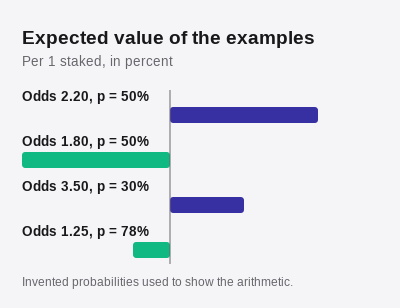
Worked example: Take the first row. At odds of 2.20 with a true 50% chance, ten bets of 10 return, on average, five wins of 22 = 110 for 100 staked: a profit of 10, or +10%. At 1.80 with the same 50% chance, the same ten bets return 90: a loss of 10.
The break-even probability
For any odds, there is a probability at which EV is exactly zero:
break-even probability = 1 ÷ odds
At 2.20 it is 45.5%; at 1.80, 55.6%. A bet has positive EV only if your honest estimate is above that line. This is also the bookmaker's implied probability before the margin is removed.
Key idea: Value is not about whether a bet wins. It is about whether the price is higher than the probability deserves. A favourite at 1.25 can be a bad bet even if it wins nine times out of ten.
EV says nothing about a single bet
A +10% bet at odds of 2.20 still loses half the time. EV describes the average over many repetitions, and the path to that average is noisy. Over a small number of bets, a positive-EV bettor can easily be behind, and a negative-EV bettor ahead. How many bets are needed before the results say anything is covered in Sample Size and When Results Mean Something.
The hard part: p
The formula is trivial; the input is not. Your probability p is an estimate, and if it is wrong, so is the EV. Common ways people get p wrong:
- Overconfidence: treating a 55% hunch as a measured probability.
- Ignoring information the market has: team news, weather, lineups.
- Small samples: building estimates from a handful of matches.
Watch out: Most bets offered by bookmakers have negative EV for most people, because the margin is built into the price. A positive EV exists only when your probability is genuinely better than the market's, which is rare and hard to prove.
Checking your estimates
A practical test of whether your probabilities are any good is to compare the odds you took with the odds at kick-off. If you consistently get better prices than the closing line, that is evidence your estimates contain information. We explain this in Closing Line Value.
Run your own numbers in the EV and closing line value calculator, and see What Is Value Betting? for the bigger picture.
- EV = p × odds − 1, per unit staked.
- The break-even probability is 1 ÷ odds; you need a higher true probability for positive EV.
- EV describes long-run averages; individual bets and short runs are dominated by variance.
Stress-test the probability assumption
Recalculate the example with a slightly lower and higher estimated chance, keeping the payout fixed. This shows how much the conclusion depends on an uncertain input. Positive expected value is a model statement about repeated comparable exposure, not a promise that an individual wager wins.
18+ only. A bet with positive expected value can still lose. See our Responsible Gambling page.