
Work through the reasoning
"I'm up 15% over 80 bets." Is that skill? Almost certainly, it is impossible to tell. Betting results are extremely noisy, and the noise shrinks slowly. This guide shows how to measure that noise with one number, the standard error, and how many bets you need before a yield says anything at all.
The noise in a single bet
At decimal odds of 2.00, a bet of 1 either wins 1 or loses 1. The spread of outcomes, measured by the standard deviation, is about 1 unit per bet. At higher odds the spread is bigger: at 3.00, a bet wins 2 or loses 1, and the standard deviation is about 1.41 units.
How the noise shrinks
When you average over n bets, the noise in your yield shrinks with the square root of n:
standard error of yield ≈ standard deviation per bet ÷ √n
| Bets | Standard error at odds 2.00 | Standard error at odds 3.00 |
|---|---|---|
| 100 | ±10.0% | ±14.1% |
| 500 | ±4.5% | ±6.3% |
| 1,000 | ±3.2% | ±4.5% |
| 5,000 | ±1.4% | ±2.0% |
| 10,000 | ±1.0% | ±1.4% |
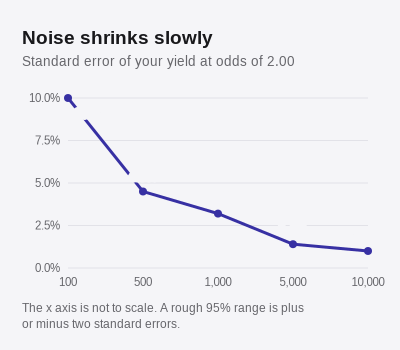
Our own calculations, assuming independent bets at constant odds and flat stakes. Real records mix odds, which makes the noise somewhat larger.
A rule of thumb
A rough 95% range for your "true" yield is your measured yield plus or minus two standard errors.
Worked example: Invented record. Over 100 bets at odds around 2.00, you made a yield of +15%. Two standard errors are ±20%, so your true yield could plausibly be anywhere from −5% to +35%. Over 1,000 bets, the same +15% would give a range of about +8.6% to +21.4%, which excludes zero and starts to mean something.
Key idea: To halve the noise, you need four times as many bets. That is why short records, even impressive ones, prove almost nothing.
Why real edges are hard to see
Genuine edges in betting markets, where they exist, tend to be small: a few percent at most. Detecting a +3% edge reliably at odds of 2.00 needs the two-standard-error range to exclude zero, which means a standard error of about 1.5% or less, around 4,500 bets. At higher odds, even more.
Faster signals
Because results take so long to become meaningful, serious bettors look at signals that are less noisy:
- Closing line value: whether you consistently beat the final price. See Closing Line Value.
- Calibration of your probability estimates: do the bets you rate at 40% win about 40% of the time?
- Process checks: are stakes, markets and timing consistent with your plan?
Survivorship and selection
Two more traps inflate impressive-looking records:
- Survivorship: among thousands of bettors and tipsters, some will have great records by luck alone, and they are the ones you hear about.
- Selective reporting: records that start after a good run, or leave out "unofficial" bets, are not records.
We look at this in Why Most Tipsters Fail: The Math.
Watch out: A short winning run is the most dangerous result a bettor can have: it feels like proof and often leads to bigger stakes. Treat any record under a thousand bets as almost entirely noise.
Use the EV and closing line value calculator to check individual bets, and keep a complete record as described in Tracking Results Like a Professional.
- The standard error of a yield is roughly the per-bet standard deviation divided by √n.
- At odds of 2.00, 100 bets leave ±10% of noise; 1,000 bets, about ±3%.
- Detecting a small real edge takes thousands of bets; use CLV and calibration as faster signals.
Keep the distribution of odds in view
The same number of settled bets can carry different uncertainty when their prices and exposures differ. Report the selection rule and all results, not only a profitable interval. A growing sample is useful only if recording and decision rules remain consistent rather than changing after every bad run.
18+ only. A bet with positive expected value can still lose. See our Responsible Gambling page.
Explore this topic: Yield uncertainty from a fixed-odds sample.