
Work through the reasoning
Bookmaker odds contain two things: an estimate of the true probabilities and a margin. To use odds as a benchmark, you have to separate them. The basic method is easy and widely used, but it makes an assumption that research suggests is often wrong. This guide compares three methods on the same example.
The example
A match with three outcomes, all odds invented for illustration:
| Outcome | Odds | Implied probability (1 ÷ odds) |
|---|---|---|
| Home (favourite) | 1.40 | 71.43% |
| Draw | 4.75 | 21.05% |
| Away (longshot) | 8.50 | 11.76% |
| Total | 104.25% |
The extra 4.25% is the overround. Each method below removes it in a different way.
Method 1: proportional
Divide each implied probability by the total (1.0425). This assumes the margin is spread in proportion to each probability.
Method 2: power
Find an exponent k such that the implied probabilities, each raised to the power k, add up to 1. Here k = 1.054. Because raising to a power shrinks small numbers more than large ones, this method takes more of the margin from longshots.
Method 3: Shin's method
Shin's method comes from a model in which the bookmaker protects itself against bettors with inside information by widening prices more on longshots. It estimates a parameter z, the share of informed money; here z ≈ 2.2%. Erik Štrumbelj's 2014 study in the International Journal of Forecasting found that Shin's probabilities were more accurate than basic normalisation.
The three results side by side
| Outcome | Proportional | Power | Shin |
|---|---|---|---|
| Home | 68.52% | 70.15% | 69.63% |
| Draw | 20.20% | 19.36% | 19.77% |
| Away | 11.29% | 10.49% | 10.60% |
| Fair odds, away | 8.86 | 9.53 | 9.44 |
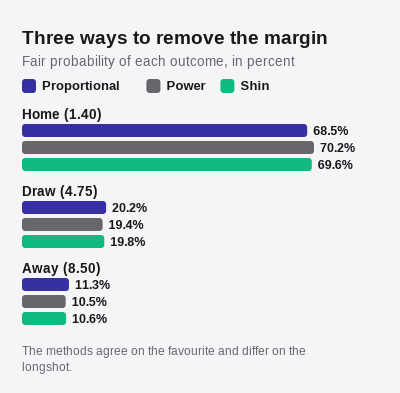
Key idea: The methods barely disagree on the favourite but clearly disagree on the longshot. Proportional removal says the away team's fair odds are 8.86; Shin's method says 9.44. If you compare a longshot price against the wrong benchmark, you may think you have found value that is not there.
Why longshots get more margin
Across many betting markets, research has documented a favourite-longshot bias: longshots tend to be overpriced relative to their true chances, and favourites slightly underpriced. A 2000 study by Cain, Law and Peel found this pattern in UK fixed-odds football betting, both in match results and in correct-score markets. Methods such as power and Shin, which take more margin from longshots, are attempts to correct for it.
Worked example: What the difference means in practice. Suppose you estimate the away team's chance at 11%. Against the proportional benchmark (11.29%) your estimate looks slightly below fair; against Shin (10.60%) it looks slightly above. The method you choose can flip the conclusion.
Two-way markets
In markets with two outcomes of similar probability, such as over/under 2.5 goals at prices near 1.90 each, the three methods give almost identical answers. The choice matters most when one outcome is much less likely than the other, which is exactly where mistakes are most expensive: a small error in a longshot's probability is a large error in its fair odds.
To run all of these methods on your own odds, use the margin removal calculator.
Which method to use
- Proportional is simple and fine for markets with two roughly equal outcomes.
- Power or Shin are better when outcomes have very different probabilities, especially with longshots.
- Whatever you use, be consistent, so that comparisons over time mean something.
Watch out: No method recovers the "true" probabilities exactly. All of them are models of how bookmakers set prices. Treat the result as an estimate with uncertainty, not a fact.
The EV and closing line value calculator shows fair odds from a price, and Closing Line Value explains why fair closing probabilities are such a useful benchmark.
- Proportional removal spreads the margin evenly; power and Shin take more from longshots.
- The methods agree on favourites and disagree on longshots.
- Research suggests Shin's method is more accurate than basic normalisation.
Retain more than one adjustment as a sensitivity check
Apply methods to a complete market snapshot and compare where their implied chances diverge. Do not choose the method simply because it makes a preferred selection look attractive. Removing an overround creates a set of modelled probabilities, not an observation of the true chances.
18+ only. A bet with positive expected value can still lose. See our Responsible Gambling page.